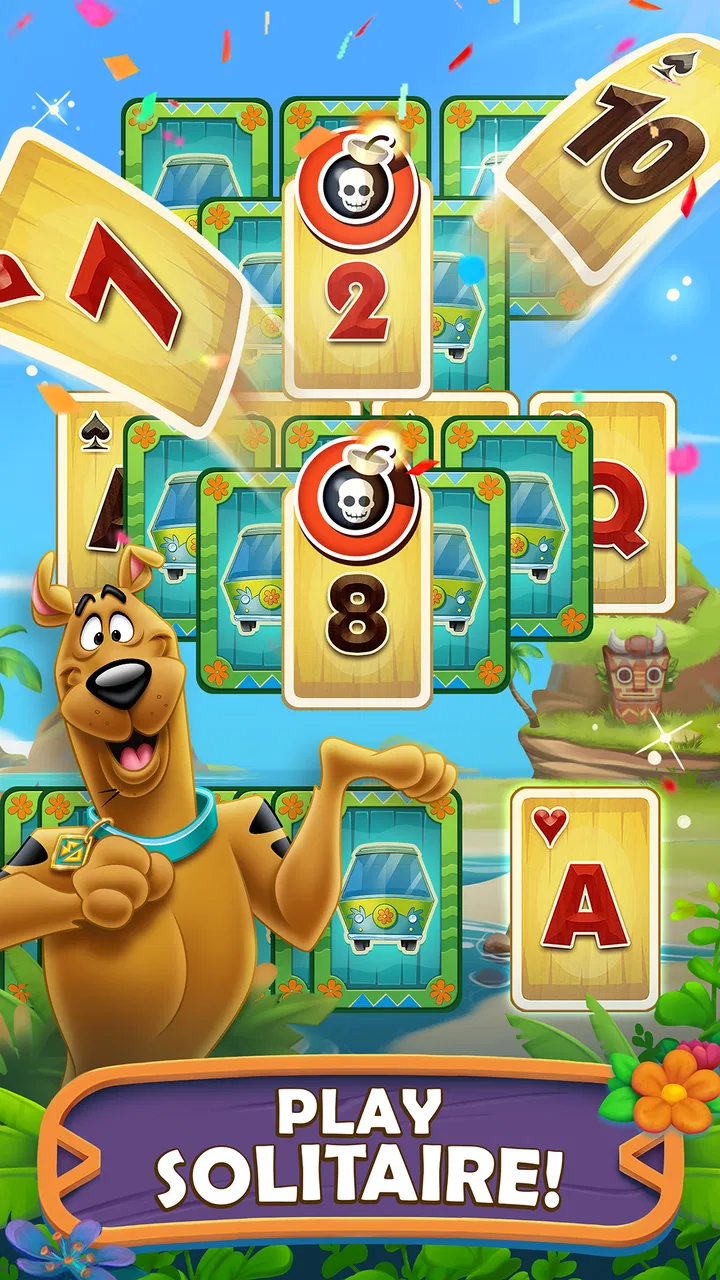
Tiki Solitaire TriPeaks
- 4.5
- Rating
- 10.00M
- Installs
- Free
- Price

 Analysis by App-foxy
I first noticed the appeal of Tiki Solitaire TriPeaks in the way it gets to the point. There is no long learning curve before the first meaningful decision. You look at the layout, choose a card that is one rank above or below the exposed card, and try to keep the chain alive. That simple action creates the whole mood of the game: quick decisions, small risks, and the constant feeling that one more move might open the board.
Scopely’s card game is free to download and aimed at Everyone, so it fits naturally into short breaks rather than demanding a serious commitment. It belongs to the solitaire family, but it is not the slow, methodical version many people associate with classic Klondike. Its TriPeaks structure gives each hand a more immediate puzzle shape, while the tropical presentation makes the experience feel lighter than a traditional card table.
I would recommend it most readily to someone who wants a casual game that can be understood in seconds but still rewards attention. I would be less enthusiastic about it for a player looking for deep deck-building, competitive card battles, or a completely uninterrupted experience without purchase prompts. The central loop is enjoyable, but the surrounding progression and monetization are important parts of deciding whether it belongs on your phone.
You May Also Like

 Blood Strike: 2.5 Anniversary
Blood Strike’s Loadouts Turn Every Drop Into a Tactical Gamble
A close look at Blood Strike’s custom loadouts: how fast access to signature weapons reshapes its battle royale rhythm, rewards preparation, and narrows the gap between fights.

 Pandora - Music & Podcasts
Pandora’s Music Is Easy to Start, but Harder to Recover
Pandora’s strength is its low-effort path from a seed to a station. Its weak spot is how much confidence it asks you to place in connection, setup, and quiet recovery.

 8 Ball Pool
 Is Built on Rivalries, Rematches, and Routine
A close look at the rivalries, rematches, shared routines, and unanswered safety questions that turn a quick pool match into a persistent mobile community.

 Samsung Music
’s Quiet Strength Is Playing What You Already Own
Its reach comes less from spectacle than from dependable access to a personal library. That simplicity is both the app’s strongest retention engine and its ceiling.

 AccuWeather: Weather Radar
AccuWeather Review: A Quick, Clear Forecast for Everyday Decisions
For everyday plans, the best forecast is the one you can understand quickly. AccuWeather makes rain timing, radar, and local conditions easy to act on, with a few trade-offs.

 Hill Climb Racing
Why Hill Climb Racing Still Turns Crashes Into One More Run
A tiny car, a bumpy hill and one more upgrade: Hill Climb Racing keeps resurfacing because its simple chaos makes every near-miss feel personal.
More From Our News Desk



How the first move turns solitaire into a decision
The opening move is easy to understand. A face-up card sits at the center of your choices, and you scan the available cards for a rank that can follow it. If the current card is a seven, for example, an exposed six or eight may continue the sequence. The rule is familiar enough for a new player to grasp immediately, but the layout makes each choice feel more deliberate than simply turning over cards from a pile.
That is where the TriPeaks format earns its place. The cards are arranged into three peaks, so clearing one area can reveal cards beneath another. You are not only asking, “What can I play now?” You are also judging which exposed card is more useful to uncover and whether a short sequence is worth preserving. A move that works immediately may be less valuable than one that opens a hidden card and gives you a better route through the layout.
My practical advice is to resist playing the first legal card automatically. I look for the move that exposes the most new information, especially when two choices are available. A visible card that removes a blocker can be more important than extending the chain by one move. This is a small habit, but it changes the game from random tapping into a compact planning exercise.
The interface is built around that decision. Cards are large enough to read quickly, and the active options are apparent without making the screen feel like a spreadsheet. The tropical theme adds personality, although players who prefer a quiet, minimalist solitaire table may find it more decorative than necessary. I like the visual identity because it separates the game from plain card apps, but it also means the experience is less restrained than old-fashioned solitaire.
There is a useful tension between planning and uncertainty. You can choose intelligently from the cards currently visible, yet the next reveal can still change the entire position. That balance prevents the game from becoming a pure calculation. Good choices improve your odds, but they do not remove the suspense of waiting to see what appears next.
Why the first decision matters more than it seems
Early in a round, I try to preserve flexibility rather than chase a long chain immediately. A sequence can feel rewarding, but using a particular rank too soon may leave the next exposed card stranded. When several cards are available, I consider which one keeps the greatest number of follow-up possibilities open. This is especially useful when the board has several partially covered groups and a single reveal can connect separate routes.
Another helpful approach is to treat the discard or waste card as part of the puzzle rather than as a dead end. I keep its rank in mind while checking the layout, because a card that is not useful now may become valuable after one reveal. That makes the board easier to read and reduces impulsive taps. The game never needs to explain this as a formal strategy lesson; the layout teaches it naturally through repeated play.
Players coming from Pyramid or Spider solitaire should adjust their expectations. Pyramid focuses on removing pairs, while Spider asks you to build ordered runs across a larger arrangement. TriPeaks is more immediate: the main question is whether you can maintain a rising-and-falling chain while uncovering the three peaks. It feels less like organizing a full deck and more like navigating a series of connected doors.
The feedback rhythm: action, response, and tension
The strongest part of the experience is the feedback after each card. You tap a legal move, the card leaves the layout, and the newly exposed space tells you what your decision accomplished. When that reveals another playable card, the response is immediate and satisfying. The game encourages you to continue not through complicated rules, but through the visible promise of one more possible move.
This rhythm gives every round a clear pulse. Action comes first, then a brief moment of inspection, then the next choice. A successful chain feels like momentum, while a blocked position creates a natural pause. I rarely feel lost because the board itself explains the next question: which cards can be played, and which hidden cards are worth reaching?
The best feedback is not the animation or decoration; it is the changing information on the table. A card disappearing can reveal the exact card needed to continue, or it can show that the route is closing. That makes the game readable even when I am playing casually. I can glance down during a short break, understand the state of the round, and decide whether to continue without reconstructing a complicated strategy.
At the same time, the feedback can encourage overconfidence. A long chain feels as if it should continue forever, but the available ranks eventually narrow. I have learned to pause after a particularly good sequence instead of tapping at speed. The extra second helps me notice whether I am choosing the best route or simply responding to the excitement of the previous move.
That pause is one of the more useful habits for new players. The game is easy to play quickly, but speed is not always the same as skill. I scan the exposed cards, identify any move that opens a peak, and only then commit. This keeps the action brisk while preserving the puzzle element that makes the format more interesting than a basic card-flipping app.
What the game communicates well, and where it can feel busy
The visual feedback generally supports the rules instead of hiding them. The tropical setting gives the game a recognizable character, and the card layout remains the main focus. Still, people who enjoy classic solitaire for its calm, plain presentation may need time to adjust. The themed environment adds energy, but it can also make the experience feel more like a casual mobile game than a quiet digital deck.
That distinction matters when choosing between this and a traditional solitaire alternative. If I want a neutral background and nothing beyond the cards, I would choose a simpler app. If I want the familiar solitaire logic with a more playful atmosphere and a stronger sense of progression, this is the better fit. Neither preference is wrong; they serve different kinds of downtime.
The feedback loop also depends on accepting that not every round will feel perfectly controllable. Some layouts are generous, while others become difficult despite sensible choices. For me, that uncertainty is part of the charm when I am playing casually, but it may frustrate someone who expects every loss to be traceable to a clear mistake. This is a game of judgment within a card-driven structure, not a pure logic puzzle with one guaranteed solution.
Reward: why a small win can lead to another round
The reward in Tiki Solitaire TriPeaks is layered. At the smallest level, there is the pleasure of clearing a card and extending the chain. At the end of a successful attempt, the satisfaction comes from having managed the layout rather than merely completing a familiar routine. The game makes progress feel close at hand, so even a short session can contain a complete arc from uncertainty to resolution.
I find the most satisfying moments are not always the longest sequences. Sometimes it is the late move that uncovers the one card needed to remove a peak, especially after the board has looked nearly blocked. That kind of turnaround gives the round a memorable finish. It also explains why the game can be tempting in short bursts: the next hand promises the possibility of a cleaner route and a better ending.
The broader progression gives the casual loop more context than a standalone deck of cards. However, this is also where the free-to-play structure becomes more noticeable. The game includes in-app purchases ranging from forty-nine cents to one hundred ninety-nine dollars per item. I would approach those options carefully and decide in advance whether I am comfortable spending anything, because the quick-turn nature of solitaire can make repeated small decisions feel harmless until they accumulate.
For me, the sensible way to play is to treat purchases as optional support rather than part of the basic definition of success. The core card decisions are enjoyable without needing to turn every difficult round into a transaction. Players who dislike any pressure around boosters, extra chances, or progression-related spending should be especially cautious and may prefer a paid solitaire app with a simpler structure.
The reward system works best when it reinforces the card play rather than replacing it. I want the feeling of earning a result through better sequencing, not simply receiving help at the moment a layout becomes inconvenient. That is why I recommend setting a personal boundary before starting. Decide whether the game is only for free, whether a small occasional purchase is acceptable, or whether any purchase prompt is a reason to leave. Making that choice beforehand keeps the game relaxing.
A realistic way to use it during the day
Imagine waiting for a friend at a café with ten minutes to spare. This is a good setting for the game because one round can be approached as a self-contained challenge. I can begin, make a few careful moves, and stop when the appointment arrives without needing to remember a complex story or coordinate with another player. The same applies to a commute as a passenger, a quiet lunch break, or the few minutes before bed.
For longer sessions, I would use a different mindset. Instead of chasing every possible reward, I focus on improving how I read the board. I ask myself whether I am preserving options, whether I am exposing cards efficiently, and whether I am confusing a lucky chain with a repeatable strategy. That turns repeated rounds into practice rather than an endless sequence of nearly identical taps.
The game is also suitable for someone introducing a younger family member to card patterns, since its content rating is Everyone and the basic rule is straightforward. I would still explain that the in-app purchase range exists and make sure purchase controls are handled appropriately on the device. The accessible rules are a strength, but accessibility should not be confused with a completely frictionless spending environment.
Session reset: the reason the next hand feels inviting
A good casual game needs a clean reset, and this one benefits from the fact that each layout has a clear beginning and end. Once a round is finished, the board no longer demands attention. I can put the phone down without feeling that I have abandoned a long campaign. When I return, the next session starts with the same recognizable rule but a different arrangement of decisions.
That reset is more important than it sounds. In a large strategy game, returning after a break may require checking objectives, resources, and several systems. Here, I only need to read the new peaks and identify the first useful sequence. The low memory burden is one of the strongest reasons to keep a TriPeaks game installed, particularly if my phone is mainly used for brief moments rather than long evening sessions.
The downside is that the reset can also expose repetition. The fundamental action remains the same from round to round: choose a neighboring rank, reveal what is underneath, and try to continue. If you need a constantly changing challenge, a story campaign, or direct competition against other people, the reset may feel like starting the same puzzle again instead of entering a fresh adventure.
Compared with Spider solitaire, this game asks less of me in terms of long-range organization. Spider can deliver a deeper sense of building and rearranging, but it usually requires more uninterrupted attention. Compared with Pyramid, TriPeaks offers a more flowing chain and a stronger sense of uncovering connected areas. Compared with Hearts, it is not a social trick-taking experience at all; it is a solitary, board-focused card puzzle. Choosing it depends on whether I want quick personal decisions rather than a full table game.
The reset also makes it easy to experiment. I can try a more conservative opening in one round, then prioritize uncovering a particular peak in the next. Because the commitment is small, mistakes become information instead of a major setback. This is where the game offers more depth than its first few minutes suggest: not through complicated rules, but through gradually improving the way I evaluate choices.
Who should skip it
I would skip this game if I wanted a completely offline-feeling, distraction-free solitaire tool with no broader mobile-game atmosphere. I would also look elsewhere if my main goal were competitive play, multiplayer card tactics, or a serious simulation of casino-style cards. The TriPeaks format is the star, and the surrounding presentation is designed to keep me returning to that format.
I would be cautious too if I tend to make impulse purchases when a game presents a difficult board or a tempting shortcut. The free entry is attractive, but the listed purchase range reaches from small amounts to very large individual items. Even when I never buy anything, I prefer to know that this structure exists before recommending the game to someone who wants a strictly controlled spending experience.
Finally, players who dislike luck influencing a puzzle may find the balance uncomfortable. Thoughtful play matters, but a favorable layout can make a round feel dramatically easier than another. I see that as appropriate for casual solitaire, not as a flaw that can be removed. If you want every outcome to be determined entirely by calculation, a fixed logic puzzle would probably suit you better.
My verdict on the complete loop
Tiki Solitaire TriPeaks succeeds because its loop is easy to feel: make one card choice, watch the layout respond, enjoy the reward of a continuing chain, reach a win or a block, and begin again with a new arrangement. The first action is immediate, the feedback is readable, and the reset is gentle enough for everyday use. That combination explains why the game has reached over ten million installs and holds a 4.5 average from around seven hundred seventy thousand ratings.
It is not trying to replace every kind of card game. Its strength is narrower and more useful: it gives me a recognizable solitaire rule set with enough visual character and decision-making to make short sessions worthwhile. Scopely has built a game that is approachable for newcomers while leaving room for experienced players to improve their sequencing and board-reading habits.
The current release is version 15.9.0, and it runs on Android starting with version 5.1. That makes it accessible to a broad range of devices, although the exact feel will still depend on screen size and how comfortable you are with a more decorated presentation. I would install it for quick, repeatable card sessions, especially when I want something more engaging than passive scrolling.
My final recommendation is positive with one condition: treat it as a casual TriPeaks game first and a progression-driven mobile product second. If you enjoy making small tactical choices, like the anticipation of uncovering the next card, and are comfortable managing optional purchases, it is an easy game to return to. If you want pure classic solitaire, deep competitive play, or absolutely no monetization friction, another card app will be a better match.
The best reason to play is the next decision, not the promise of a perfect run. When I approach each hand that way, the game feels relaxed, tangible, and pleasantly replayable rather than demanding. That is the point at which its action-feedback-reward-reset loop works exactly as intended.
FAQs for Tiki Solitaire TriPeaks
01What is Tiki Solitaire TriPeaks?
Tiki Solitaire TriPeaks is a popular card game app available on both Android and iOS platforms. It combines the classic game of Solitaire with unique tropical-themed challenges. Players can embark on a journey through various islands, unlocking levels and collecting rewards along the way. It's a fun twist on traditional Solitaire games.
02Is Tiki Solitaire TriPeaks free to play?
Yes, Tiki Solitaire TriPeaks is free to download and play. However, it does offer in-app purchases that allow players to buy extra coins and boosters. These purchases can enhance gameplay but are not necessary to progress through the game, making it accessible for both casual and dedicated players.
03What are the system requirements for Tiki Solitaire TriPeaks?
For Android users, Tiki Solitaire TriPeaks requires Android 4.4 and up, while iOS users need iOS 9.0 or later. The game is optimized for both smartphones and tablets, ensuring a smooth experience across all devices. Ensure your device meets these requirements for optimal performance.
04Are there any social features in Tiki Solitaire TriPeaks?
Yes, Tiki Solitaire TriPeaks includes various social features. Players can connect the game to their Facebook accounts to compete with friends, share progress, and send or receive gifts. This adds a social dimension to the game, making it more engaging and interactive.
05How does the game ensure challenging gameplay?
Tiki Solitaire TriPeaks offers multiple levels with increasing difficulty, ensuring a challenging experience. The game incorporates various obstacles and power-ups, requiring strategic thinking and planning. Regular updates often introduce new levels and events, keeping the gameplay fresh and exciting for all players.
Pros
- Engaging and addictive gameplay.
- Vibrant and colorful graphics.
- Daily challenges keep it fresh.
- Smooth user interface experience.
- Free to play with optional purchases.
Cons
- In-app purchases can be pricey.
- Requires internet connection.
- Ads can be frequent.
- Limited lives can frustrate players.
- Game progression can be slow.

Tiki Solitaire TriPeaks
Gallery